Free this Black Friday weekend
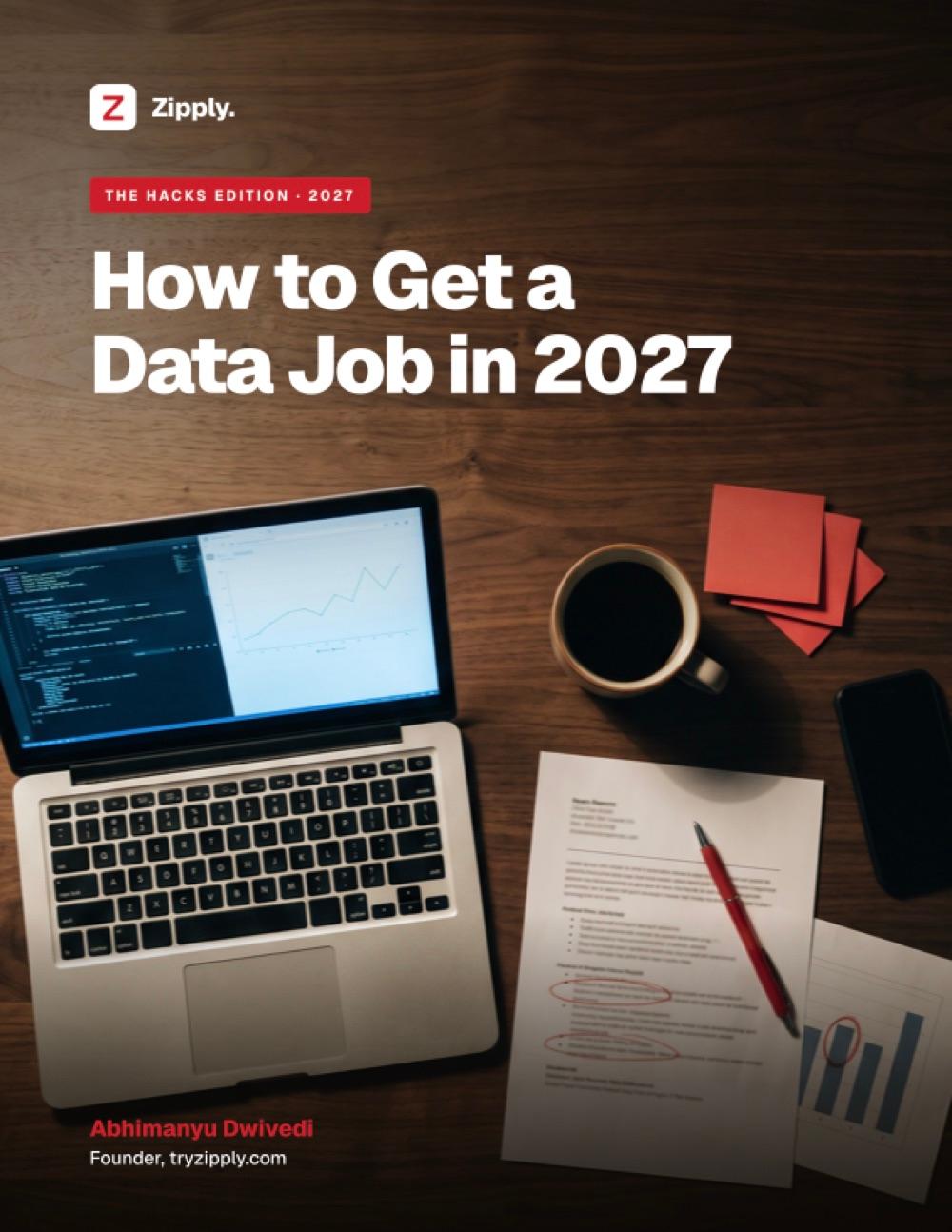
How to get a data job in 2027.
For data scientists, data engineers, analytics engineers, ML engineers and analysts in the US who have shipped real work and keep losing at the screen.
- 12 chapters, 73 pages
- 44 small things you can do the same day, four at the end of every chapter
- Every number dated and sourced, because job-market numbers age fast
What the book argues
The problem is not your skill. It's the first half minute.
Each opening draws far more applications than it used to, so the first screen is fast and blunt. People who got through mostly did three things.
01
Fewer, truer fits, early
Not hundreds of loose matches. A short list where the fit is obvious in a few seconds, applied to while it's fresh.
02
The truth, specifically
A CV that survives a quick read and the follow-up question, with every number something you can explain.
03
One human route in
A referral, a note to the hiring manager, a recruiter who already knows your name.
From the book
Four of the 44, word for word.
Chapter 3
The 30-second test
Give your CV to a friend, take it back after 30 seconds, and ask: what do I do, at what level, and where have I done it? If they cannot answer all three, the top third of your first page needs work.
Chapter 4
Do the plain-text test
Open your CV as a PDF, select all, and paste it into a plain text editor. If the text comes out in the wrong order, an applicant tracking system may read it the same way.
Chapter 3
Apply on the employer's own site
If you find a role on an aggregator, open the company's careers page and find it there. It confirms the role is still open, and your application does not arrive as one of the one-click flood.
Chapter 4
Keep a numbers sheet
One line for each number on your CV: the baseline, how it was measured, over what period, and which part was yours. Read it before every interview.
What's inside
Twelve chapters, one page to keep.
- 01The Market vs the Job SeekerWhy the market is smaller than 2021, mostly senior, and fast and blunt at the first screen.
- 02How People Actually Get HiredWhere hires really come from: referrals, sourcing, and the applications that make it through.
- 03What Happens When You Apply to the JobThe pile your application lands in, and the few seconds it gets.
- 04A CV That Survives 31 SecondsA first page that says what you do, at what level and where, in one read.
- 05How to Target the Right Job for YouFewer roles that truly fit, found early, on the employers' own boards.
- 06Finding a Way In Without a Big NetworkOne human route in: a hiring manager, a recruiter, a thread that already knows your name.
- 07Inside the Interview LoopLoops run longer than in 2021. What the large employers publish about theirs, and which rounds now carry the most weight.
- 08Coding Interviews With and Without AIThe rules differ from company to company. Prepare for both, and ask.
- 09Interviews for Data and ML RolesSQL under time pressure, metric questions, business judgement, and how to present analytics work as a result.
- 10How to Handle a LayoffFor anyone laid off this year, with a large, experienced crowd looking at the same time.
- 11Running the Search Without Burning OutThe search as a weekly system you can run with a spreadsheet and a calendar.
- 12TL;DREverything on one page to keep next to your desk.

Who wrote it
Abhimanyu Dwivedi, founder of Zipply.
I read every signup and submit each application we send myself. This book is written from what I see doing that for real job seekers, plus the public data and the first-hand stories people share. The stories are stories we read, not a survey, and the book says so wherever it uses one.
There are no promises in it. Nobody can promise you an interview. What it can do is help you spend your hours where they count.